Calacatta Gold Quartz represents the intersection of luxurious aesthetics and modern performance in engineered stone surfaces. Emulating the dramatic beauty of Calacatta marble with crisp white backgrounds and bold gold and gray veining, this quartz variant has become a staple in high‑end residential and commercial interiors. Its appeal extends far beyond simple countertop surfaces, offering opportunities for cohesive design across kitchens, bathrooms, and architectural accents. With its non‑porous composition and engineered durability, Calacatta Gold Quartz balances both visual sophistication and functional resilience, a combination that appeals to designers, architects, and discerning homeowners alike.
In this comprehensive guide, we explore Calacatta Gold Quartz in depth: what it is, how it’s made, technical attributes, performance benefits, installation considerations, maintenance practices, cost factors, design integration, material comparisons, and real‑world applications. Through meticulous analysis and expert perspectives, this article empowers professionals and property owners to make informed decisions about incorporating Calacatta Gold Quartz into their environments with confidence and clarity.
What is Calacatta Gold Quartz?
Calacatta Gold Quartz is a manufactured stone surface engineered to replicate the luxurious appearance of natural Calacatta marble while addressing the inherent limitations of natural stone. Engineered quartz countertops like Calacatta Gold are composed primarily of natural quartz aggregates (typically exceeding 90%), bound together with polymer resins and pigment to create a stable, durable slab. This composition results in a surface that closely mimics the depth, variation, and intricate veining of marble without the high maintenance and porosity associated with natural stone.
Engineered Quartz vs. Natural Stone
While natural marble exhibits organic variation and porous characteristics, engineered quartz offers predictable consistency and uniform quality. Calacatta Gold Quartz specifically combines the refined, elegant veining reminiscent of Italian marble with the structural advantages of a man‑made material. Natural marble such as true Calacatta is prized for its unique veining patterns, but it remains softer, more porous, and prone to staining and etching when exposed to acids and daily use. Quartz, by contrast, is non‑porous and highly resistant to stains, making it suitable for high‑use spaces like kitchens and bathrooms.
Manufacturing Process
The creation of Calacatta Gold Quartz involves blending crushed quartz crystals with specialized polymer resins and colorants in a controlled factory setting. High compression and vibration techniques ensure a dense, cohesive slab with minimal internal voids. The carefully calibrated gold and gray veining is achieved through precise pigment placement, allowing manufacturers to engineer aesthetics while maintaining performance.
Machine polishing (or honed texturing) produces finishes that range from glossy to matte, allowing designers to tailor surface reflectivity to the space design. The result is a product that delivers both optical depth and technical resilience, meeting modern design standards for luxury interiors.
Key Features & Technical Specifications
Calacatta Gold Quartz offers a range of technical attributes that distinguish it from both natural stone and standard quartz products.
Color, Pattern, and Visual Variation
The hallmark of Calacatta Gold Quartz is its bright white base adorned with striking gold veining and subtle gray accents that emulate the visual complexity of natural marble. These warm tones bring a sophisticated elegance to interiors and allow for flexible coordination with cabinet finishes, hardware metals, and tile selections.
Unlike some standard white quartz options, which can appear homogeneous, Calacatta Gold Quartz delivers dynamic veining and visual depth, creating a focal point in kitchens and bathrooms alike. The consistency of engineered slabs ensures reliable pattern replication, an advantage when matching multiple slabs for large installations.
Thickness Options and Finishes
Calacatta Gold Quartz is typically available in 2cm and 3cm thicknesses, accommodating standard countertop depths as well as waterfall edges and integrated architectural features. Finishes range from high‑polish, which enhances the reflective quality of the surface, to honed or textured finishes that reduce glare and emphasize a tactile experience.
Performance Characteristics
From a performance perspective, Calacatta Gold Quartz excels across multiple metrics:
- Non‑Porous Structure: Engineered quartz does not absorb liquids, making it naturally resistant to stains from wine, oils, coffee, and other common household substances.
- Scratch and Chip Resistance: Its dense composition withstands regular cutting and handling, giving it an advantage over softer stones.
- Moderate Heat Tolerance: While quartz is more heat‑resistant than many solid surfaces, it is not heat‑proof; trivets and pads are recommended to protect against thermal shock.
The combination of these features makes Calacatta Gold Quartz not only visually compelling but also technically robust for demanding interior environments.
Benefits of Calacatta Gold Quartz
Durability and Everyday Performance
Calacatta Gold Quartz stands out for its exceptional durability. Engineered quartz surfaces resist scratches, chips, and impact damage that commonly afflict softer stones like marble. This robust performance is particularly valuable in high‑traffic areas such as culinary workspaces and family bathrooms.
In comparison to natural Calacatta marble, which is revered for its aesthetics but vulnerable to etching from acidic substances, quartz offers a practical alternative. The non‑porous structure not only inhibits liquid penetration but also prevents bacterial growth, enhancing hygiene and making it a preferred choice in kitchens, where food safety is critical.
Low Maintenance Requirements
One of the defining advantages of Calacatta Gold Quartz is its low maintenance profile. Routine upkeep typically involves a mild soap and water solution, eliminating the need for periodic sealing or specialized cleaners that natural stones often require.
This ease of care, combined with resistance to stains and surface damage, makes quartz highly suitable for commercial kitchens, hospitality environments, and luxury residential interiors, where consistency and reliability of surface performance are paramount.
Design Flexibility and Aesthetic Impact
Beyond functional benefits, Calacatta Gold Quartz offers exceptional design flexibility. Its balanced palette of white, gold, and gray complements a wide range of design styles, from minimalistic, contemporary spaces to traditional interiors with rich cabinetry and metallic accents.
Design professionals often exploit this versatility by extending quartz surfaces from countertops into backsplash elements, wall cladding, or even fireplace surrounds, creating cohesive design themes throughout a space.
Together, these performance and aesthetic advantages underscore why Calacatta Gold Quartz is increasingly specified in sophisticated architectural projects and high‑end renovations.
Ideal Applications in Your Home
Calacatta Gold Quartz’s robustness and elegance position it for use in a diverse array of residential and commercial environments.
Kitchen Countertops and Islands
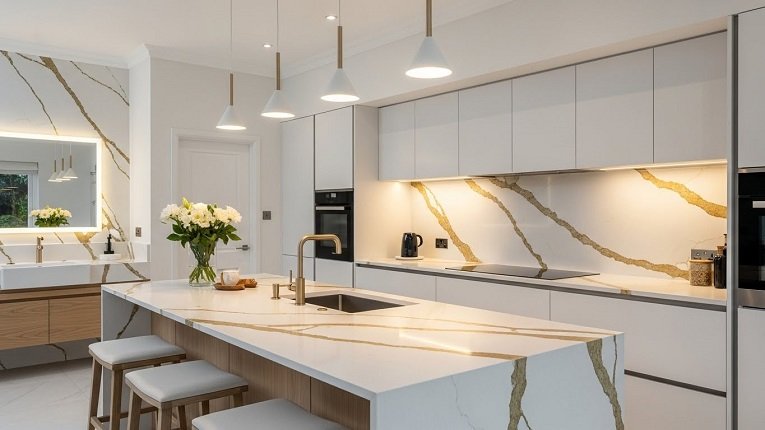
In kitchens, Calacatta Gold Quartz functions as both a functional work surface and a visual centerpiece. Its non‑porous nature reduces concerns related to spills and stains from common kitchen activities, while its bold veining creates a refined focal point that elevates design schemes across classic, transitional, and contemporary kitchens.
Designers often specify waterfall edges, where the quartz surface wraps down the sides of islands, to maximize visual continuity and create a dramatic architectural statement. These applications testify to the material’s structural uniformity and allow for seamless transitions across horizontal and vertical planes.
Bathroom Vanities and Backsplashes
Calacatta Gold Quartz is equally suited for bathroom vanities, where its hydrolysis‑resistant surface withstands frequent exposure to water and personal care products. Because it does not require sealing, it provides a hygienic alternative to more porous stones that demand ongoing maintenance.
Backsplashes executed in matching Calacatta Gold Quartz integrate texture and pattern behind sinks and fixtures, enhancing visual width and drawing the eye upward, an effective technique in both small and large bathroom plans.
Accent Walls and Other Architectural Features
Extending quartz beyond horizontal surfaces into vertical applications such as accent walls or fireplace surrounds introduces consistency and luxury throughout an interior. By matching veining directions between adjacent slabs, skilled fabricators can create stunning, bookmatched surfaces that mimic bespoke architectural stonework.
Given its engineered stability, quartz can be integrated into open spaces without the concerns of cracking or movement associated with natural stone installations.
Design Inspiration & Style Pairings
The distinctive visual qualities of Calacatta Gold Quartz inspire diverse design strategies across interior typologies.
Contemporary Kitchens
In contemporary kitchens, designers often pair Calacatta Gold Quartz with minimalist cabinetry in matte finishes, such as flat‑panel white or deep charcoal, to emphasize the stone’s vibrant veining. The contrast between subtle cabinetry and the dynamic pattern of the quartz creates visual tension that underscores modern elegance.
Complementary hardware in brushed brass or matte black enhances the warm gold accents while maintaining a restrained palette. Because the surface is engineered for uniformity, lighting plays a critical role; under‑cabinet LED illumination amplifies the depth of the white and gold tones, enhancing spatial perception.
Classic and Traditional Interiors
For traditional or classic interiors, Calacatta Gold Quartz pairs seamlessly with raised‑panel cabinetry, ornate hardware, and warm wood tones. The gold veining harmonizes with rich walnut or cherry finishes, while the white background provides visual relief against heavier wood grains.
In these contexts, quartz can be used not only for countertops but also for dramatic features such as built‑in niches and decorative backsplash patterns, reinforcing a sophisticated yet timeless design language.
Transitional Spaces
Transitional designs leverage Calacatta Gold Quartz’s versatility by integrating elements from both modern and traditional palettes. For instance, pairing quartz worktops with warm gray cabinets and brass accents creates a balanced, layered aesthetic. Similarly, installation in open‑plan spaces fosters continuity across functional zones while preserving individual style elements.
Installation & Fabrication Considerations
Calacatta Gold Quartz requires careful planning and expert fabrication to achieve its full potential.
Professional Installation
Due to its density and weight, professional installation is imperative for quartz surfaces. Certified fabricators use CNC cutting equipment to precisely shape slabs, ensure accurate edge profiles, and accommodate cutouts for sinks, cooktops, and integrated features. Improper handling or installation can lead to structural stress, cracking, or alignment issues.
Waterfall edges, mitered corners, and integrated backsplash detailing require advanced skill; engaging an experienced fabricator ensures continuity in veining and alignment across multiple planes.
Edge Profiles and Custom Details
Edge profiling (e.g., eased, bullnose, ogee) influences both aesthetics and functionality. Popular choices such as eased or bevel edges offer a clean, contemporary look, while more elaborate profiles may suit traditional contexts. Custom details like integrated drains or waterfall edges typically increase fabrication time and overall installation cost.
Seams and Slab Matching
For larger installations requiring multiple slabs, identifying veining patterns and aligning seams is essential for achieving visual continuity. Fabricators often provide mock‑ups or physical templates during the planning stage to confirm veining direction and seam placement.
Maintenance & Care Guide
Maintaining Calacatta Gold Quartz is straightforward but requires adherence to best practices.
Daily Cleaning
Routine cleaning typically involves a soft cloth or non‑abrasive sponge with warm water and mild soap. Because quartz is non‑porous, liquids do not penetrate the surface, simplifying daily maintenance. Avoid harsh chemical cleaners, particularly those containing bleach or strong acids, as they can damage the resin components.
Stain Management
Though engineered quartz resists staining, spills should be wiped promptly to prevent potential surface residue. For more persistent spots, a gentle cleaner designed for quartz surfaces, combined with a soft pad, is often effective.
Heat Protection
While quartz tolerates moderate heat, thermal shock, sudden temperature changes from hot cookware placed directly on the surface, can cause damage. Use trivets or protective pads to safeguard the countertop during cooking activities.
Avoiding Abrasives
Abrasive scouring pads or steel wool should be avoided, as these can mar the finish. Instead, soft microfiber cloths and dedicated stone cleaners maintain surface integrity over time.
Cost & Value: What to Expect
Calacatta Gold Quartz positions itself in the mid‑premium to premium range of quartz surfaces. Installed costs often fall between approximately $70 and $120+ per square foot, influenced by slab grade, edge profiles, installation complexity, and geographic labor rates.
Material‑only prices, excluding fabrication and installation, typically range from around $30 to $75 per square foot. Because this material offers consistent aesthetics and low maintenance, its lifecycle cost, factoring in durability and reduced upkeep, may deliver greater value than natural stone alternatives that require ongoing sealing and specialized care.
When budgeting, stakeholders should also consider additional factors such as edge profiling, sink cutouts, and any custom fabrication required. These can influence the final price significantly, especially in complex layouts or when waterfall edges and large islands are involved.
Comparing Calacatta Gold Quartz with Other Materials
Quartzite
Quartzite is a natural stone prized for its strength and heat resistance, but it is porous and typically requires periodic sealing. Calacatta Gold Quartz, by contrast, is non‑porous and low‑maintenance, though it is generally less heat‑resistant than quartzite. The engineered uniformity of quartz also provides a more consistent visual appearance, a key advantage in design continuity.
Natural Marble
Calacatta marble offers unique veining and pure luxury, but it is susceptible to etching and stains from daily kitchen use. Calacatta Gold Quartz replicates this aesthetic without such vulnerabilities. Quartz surfaces also eliminate the need for sealing, a recurring maintenance task for marble installations.
Granite
Granite provides excellent heat resistance and a distinctive natural appearance, but its pattern variation can be unpredictable, and it requires sealing for optimal performance. Calacatta Gold Quartz delivers both predictable aesthetics and superior stain resistance, supporting design agendas that prioritize both durability and elegance.
Key Takeaways
- Calacatta Gold Quartz combines the luxurious look of marble with engineered performance benefits.
- Non‑porous and low‑maintenance construction resists stains and bacterial growth.
- Available in diverse finishes and thicknesses to meet design and functional requirements.
- Professional fabrication and installation are crucial for optimal results.
- Cost varies by slab grade, edge profile, and installation complexity but offers excellent lifecycle value.
Conclusion
Calacatta Gold Quartz stands as a premier choice for sophisticated interiors that demand both exceptional aesthetics and engineered performance. Its distinctive veining and color palette elevate spaces, while its technical characteristics, including non‑porosity, durability, and low maintenance, support long‑term functionality in kitchens, bathrooms, and architectural applications.
For design professionals and informed homeowners alike, understanding the nuances of material selection, cost implications, installation requirements, and maintenance considerations is crucial. Calacatta Gold Quartz not only meets these criteria but often surpasses expectations when thoughtfully integrated into a renovation or new construction scheme.
Whether specified for a statement kitchen island, a streamlined bathroom vanity, or a unified wall surface, Calacatta Gold Quartz harmonizes luxury and practicality, making it a material worth serious consideration in contemporary design practice.
FAQs
1. Is Calacatta Gold Quartz more durable than natural marble?
Yes. Calacatta Gold Quartz is engineered for superior durability and stain resistance compared to natural marble, which is softer and more susceptible to etching and staining.
2. Do Calacatta Gold Quartz countertops need sealing?
No. Unlike natural stone, quartz is non‑porous and does not require periodic sealing.
3. What is the typical cost range for Calacatta Gold Quartz?
Installed prices generally range from about $70 to $120+ per square foot, depending on slab quality and installation complexity.
4. Can Calacatta Gold Quartz be used for backsplashes and walls?
Yes. Its consistent aesthetics and durability make it suitable for walls, backsplashes, and other vertical applications.
5. How do I protect quartz from heat damage?
Use trivets or heat pads, as quartz resists moderate heat but can be damaged by thermal shock from hot cookware.